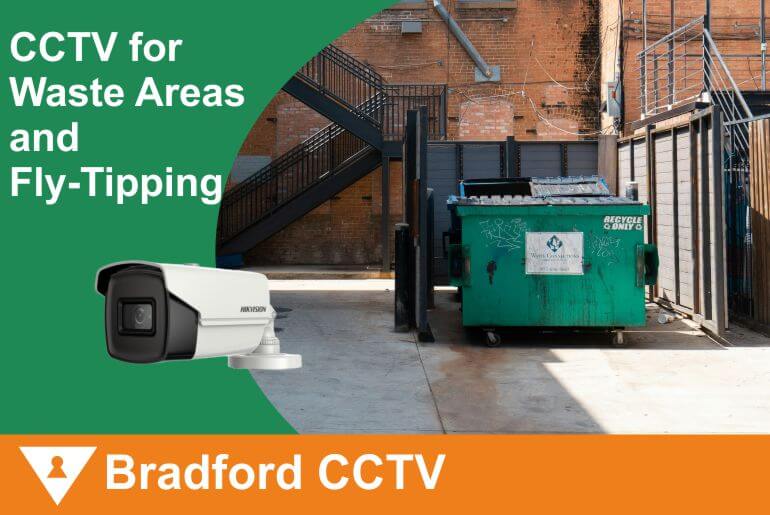
Business waste area CCTV –
Commercial CCTV systems naturally concentrate on the areas businesses consider most important. Entrances, reception areas, loading bays, car parks and valuable stock usually receive plenty of attention. Yet one part of a commercial site can generate repeated problems while remaining almost completely overlooked—the waste and bin storage area.
For businesses across Bradford, commercial waste is both an operational necessity and an ongoing expense. Unfortunately, poorly monitored bin compounds can attract unauthorised dumping, theft of materials and misuse by people who have nothing to do with the business.
Fly-tipping is an obvious concern. A business may arrive in the morning to discover furniture, building waste, tyres or household rubbish deposited alongside its commercial bins. Removing it can cost money and consume staff time, particularly when the person responsible cannot be identified.
Strategically positioned CCTV can provide valuable evidence of when the waste appeared, how it arrived and potentially which vehicle or individual was responsible.
The problem isn’t restricted to obvious fly-tipping. Commercial bins themselves can be misused. Members of the public or neighbouring organisations may dispose of waste in containers paid for by another business. When this happens repeatedly, bins fill more quickly and collections may need to become more frequent, increasing operating costs.
Some commercial sites face the opposite problem: materials disappearing.
Scrap metal, pallets, reusable containers and other items stored temporarily near waste areas may have residual value. If these locations are secluded from the main building, unauthorised individuals can access them without attracting attention.
Waste compounds can also become an access point into the wider premises. They are often located behind buildings, beside service roads or near perimeter fencing where natural surveillance is limited. Reviewing CCTV coverage of these areas can therefore contribute to wider site security as well as waste management.
Camera positioning requires careful thought. Simply pointing a camera towards a row of bins may establish that somebody was present but provide little useful evidence of how they reached the site. Effective design considers vehicle approaches, pedestrian access and the wider environment around the compound.
Lighting conditions are particularly relevant. Waste collections frequently take place early in the morning, while unauthorised dumping may occur after businesses have closed. Cameras therefore need to provide useful footage throughout changing light conditions rather than only during normal working hours.
Modern CCTV analytics can make monitoring these quieter areas considerably more practical. Rather than expecting somebody to watch cameras continuously, appropriate systems can help identify activity within defined areas and make recorded events easier to locate afterwards.
Businesses should also consider how waste operations change over time. Additional skips may be introduced during refurbishment projects, new recycling containers added or compounds relocated as premises expand. Temporary arrangements can create gaps in existing surveillance if CCTV is not considered alongside those changes.
Recorded footage can have operational benefits too. Businesses experiencing missed collections can verify whether waste contractors attended when expected. Managers can also establish whether access was obstructed by parked vehicles or whether containers had been positioned incorrectly when collection was attempted.
As with any commercial CCTV installation, responsible use and data protection remain important. Cameras should be positioned for legitimate business purposes and footage should only be accessible to authorised personnel.
For Bradford businesses operating from industrial units, offices, retail premises and larger commercial sites, waste areas may not initially appear to justify the same attention as a front entrance or loading bay. However, repeated misuse can create significant costs over the course of a year.
A professional CCTV review can establish whether these less obvious parts of the premises receive appropriate coverage and whether existing cameras could be repositioned to provide greater value.
Commercial CCTV works best when it reflects the problems a business actually experiences. Sometimes the most useful camera on the entire site isn’t watching the front door or valuable stock. It is quietly monitoring the place everybody else forgot about.